
The Autonomous Future of Financial Services Collaboration

Trust, governance and secure AI agents

The Autonomous Future of Financial Services Collaboration

Trust, governance and secure AI agents

Interested in learning more?

Over the past 18 months, financial institutions have moved beyond tentative experimentation with generative AI. Early use cases such as assisting analysts with information search and the summarization of regulatory filings were confined to incremental productivity gains.

A more consequential shift is now underway. Advances in autonomous AI agents are enabling systems that can coordinate workflows, interact across enterprise platforms and execute complex research and operational tasks with limited human intervention. This marks a transition from AI as a decision-support tool to AI as an operational capability embedded within the organisation.

Large institutions are already signalling how this transition is unfolding in practice. JPMorgan Chase announced a move from using isolated generative tools towards AI-driven workflows, becoming the first major bank to implement generative AI for its employees. At Goldman Sachs, generative and agent-based systems have been embedded into internal research and development platforms, coordinating tasks across data sources while operating within established governance frameworks.

The strategic question for leadership teams is no longer whether such capabilities will be adopted, but how they are governed, integrated and scaled without undermining control or accountability.

At Symphony, we believe that institutions that thrive in the AI era will be those that confidently and safely embrace the possibilities of agentic AI, with governance embedded in their core operations. This principle is the foundation of our AI strategy, where we become a trusted partner for secure AI collaboration in the financial markets.

Intelligence and autonomy rise in the new era of AI agents

The next frontier of agentic AI goes beyond simply answering questions, as these agents can plan, reason, coordinate across multiple applications and initiate actions. In a high-stakes industry such as financial services, where data sovereignty, conduct controls and auditability are non-negotiable, institutions must manage further complexity.

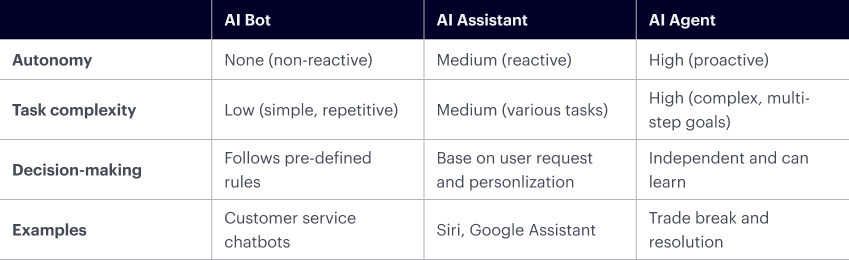
What are the key differences between a bot, an assistant and an agent?
AI Bot AI Assistant AI Agent
AutonomyNone (non-reactive)Medium (reactive)High (proactive)
Task ComplexityLow (simple, repetitive)Medium (various tasks)High (complex, multi-step goals)
Decision-Making Follows pre-defined rulesBased on user requests and personalizationIndependent and can learn
ExamplesCustomer service chatbotsSiri, Google AssistantTrade break and resolution

Historically, organizations managed risk through well-defined human processes, deterministic software and strict information boundaries. AI agents change this control model by learning, adapting and interacting across systems as dynamic actors.

This evolution poses some fundamental questions:

  • How can we validate and govern agent actions at scale?
  • What measures ensure that autonomy does not introduce risk or bypass conduct rules?
  • How do we benefit from agent-driven efficiency without sacrificing confidentiality, traceability or compliance?

Financial institutions are moving beyond LLM experimentation to an operational model of “supervised autonomy” where humans remain accountable and AI enhances work while remaining under oversight.

Symphony’s infrastructure provides a proven foundation for this evolution. Through our open APIs and extensible platform architecture, customers have securely deployed thousands of intra-firm and inter-firm bots to support messaging and workflow automation needs. Extending this model from rule-based bots to supervised AI agents is, therefore, a natural progression building on a trusted foundation that financial institutions already rely on at scale.

Symphony as the control framework for responsible autonomy

Symphony was founded on a simple principle: to empower financial professionals to securely communicate, collaborate and optimize business workflows without compromising compliance and control. Our secure communication architecture already connects firms, systems and workflows with trust boundaries and auditability at its core.

This positions us uniquely for the coming AI wave.

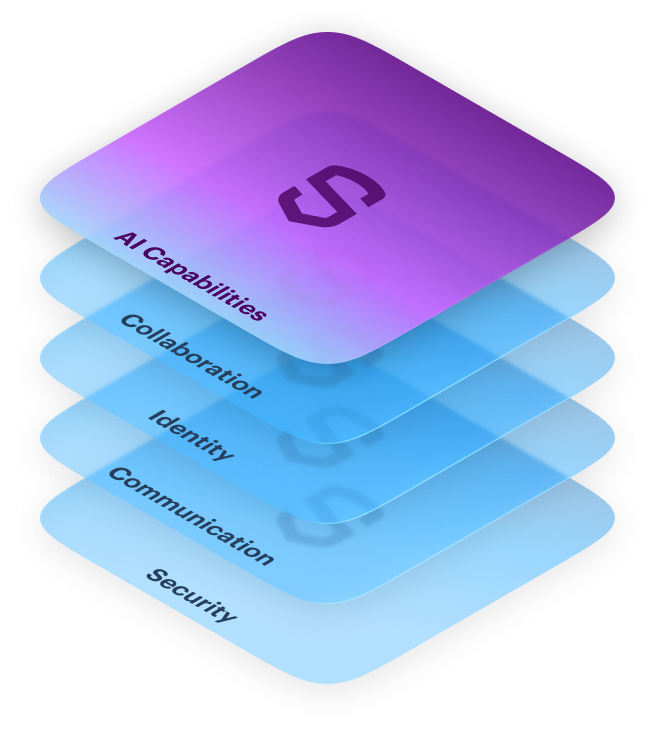
As institutions prepare to deploy autonomous agents across research, client servicing, trade lifecycle management and regulatory workflows, they will require:

  • Digital identity and access controls for agents
  • Interoperability across internal and external systems
  • Encryption, data residency and privacy guarantees
  • Policy-enforced guardrails and human approval checkpoints
  • Complete audit trails and traceability of agent decisions
  • A safe execution framework to orchestrate actions across intra- and inter-firm environments

Our vision is to extend our proven secure messaging, voice and workflow infrastructure to enable these capabilities and provide a secure framework for AI-assisted and agent-driven workflows within the financial ecosystem.

AI Innovation, human judgement and trust

Regulators and the industry’s emerging consensus remain that AI will not replace human judgment in regulated financial operations. Instead, it will amplify qualified professionals by automating analysis, documentation, routing and task execution, allowing human experts to focus on strategy, risk decisions and client outcomes.

Symphony is already a trusted partner for secure collaboration and I’m excited by the opportunities we have to collaborate closely with our engaged customers. By extending this to support AI in real enterprise environments, we can align with institutional practices to build a future where AI agents become trusted components of daily financial workflows.

Symphony and the future of AI in financial services

Our AI strategy marks a new chapter in AI collaboration with our community, including the exciting integration of our customers’ agentic capabilities into our WhatsApp offering.

We will provide the:

  • Solutions: In-house capabilities to custom-build agents or harness off-the-shelf partner agents for deployment in a controlled manner.
  • Network: A secure, monitored community where customers can bring their own agents to join 500k+ verified financial users.
  • Intelligence: Scalable tools with user insights from unstructured messaging data and voice data. Additional AI assistants will also enhance productivity and add efficiency with summarization capabilities.

This strategy leverages our existing platform capabilities to provide a secure environment for agent execution. It includes human-in-the-loop controls for sensitive actions, verified agent identities, appropriate permissions and supervision. We also ensure interoperability with firm-approved AI models and tools, as well as controlled data flows across internal and external communication environments.

We are entering an era where collaboration extends beyond people to include intelligent systems. Symphony will ensure that as AI agents join the workflow, they do so safely, securely and with trust embedded from day one.

Financial services stand on the verge of a significant productivity transformation. Done responsibly, AI will elevate the work of every analyst, banker, trader, compliance officer and customer service professional.

We are proud to help build a future where secure, auditable AI enables autonomy in financial services, without compromise.

What’s next…

This piece is the first in our AI Trust & Governance series. Next, we explore financial use cases and the benefits of Model Context Protocol (MCP) to deploy and scale AI in regulated industries.

Interested in learning more?

Related resources